Meshery MCP Server: Architecture and Registration Design
Status: draft for community review. This aligns with the scaffold already up in PR #28 (mark3labs/mcp-go, stdio transport, environment config, CI). Feedback on any section is welcome, especially section 3.
1. Problem and goals
AI assistants cannot work with Meshery today. An engineer using Claude, Cursor, or Copilot has no way to list designs, inspect a cluster, resolve a component schema, or deploy a pattern, so they end up copying YAML back and forth by hand. The Meshery MCP Server closes that gap by exposing Meshery through the Model Context Protocol.
The server gives an agent three ways to work with Meshery:
- Observe through read-only resources backed by MeshSync-discovered topology.
- Act through tools covering the design lifecycle, cluster connections, the model and component registry, environments and workspaces, and performance testing.
- Be steered through prompt templates for guided workflows like design review and application deployment.
2. Scope and non-goals
In scope: stdio and streamable HTTP transports, the tool/resource/prompt surface, a shared Meshery client as the single integration boundary, authentication with multi-instance contexts, tests, CI, and a released binary and container image.
Non-goals: this is the MCP Server, separate from the Meshery AI Adapter work (BYOM, Ollama). Resources are read-only and never mutate Meshery state. No credentials are exposed in logs or tool output.
3. Core decision: standalone process, first-class Meshery citizen
One question shapes the whole build: should the MCP server be written on the Meshery adapter framework, or standalone? This section takes a position.
The adapter framework makes Go binaries that register with Meshery Server, authenticate, and register capabilities. It exists for adapters that connect Meshery to infrastructure such as Istio or Kuma, and it manages the connection lifecycle between Meshery Server and the adapter.
The MCP server is a different kind of component. Its clients are AI agents, not Meshery Server. Its job is to translate the MCP protocol into Meshery API calls. The adapter registration lifecycle does not apply here, and building on it would couple the server to machinery it does not use and slow the project down.
Position: the MCP server is a standalone Go process that is a first-class Meshery citizen through conventions rather than through the adapter framework.
- Go, matching the Meshery ecosystem.
- MeshKit for error codes and structured logging, per the contributor guide.
- Meshery schemas for connection, component, and relationship data.
- A shared Meshery client as the only integration boundary.
SDK: mark3labs/mcp-go v0.57.0, already proven in the PR #28 scaffold with in-process client testing (Initialize, ListTools, CallTool in server_test.go). Chosen over the official go-sdk for its first-class tool registration and testability. Revisitable if the official SDK closes the gap.
| Option | Pros | Cons |
|---|---|---|
| Adapter framework | Uniform registration, built-in auth | Built for data-plane adapters; its lifecycle does not fit a protocol server; slower to start |
| Fully standalone, no conventions | Fastest to start | Risks drifting out of the ecosystem |
| Position above | Fast to start, first-class citizenship | Requires discipline to stay on conventions |
This position is open for debate. The alternative is worth attacking: if the MCP server should register with Meshery Server as an adapter, the counter-argument needs to show what the adapter lifecycle gives an AI-facing protocol server that the shared client does not.
4. System architecture
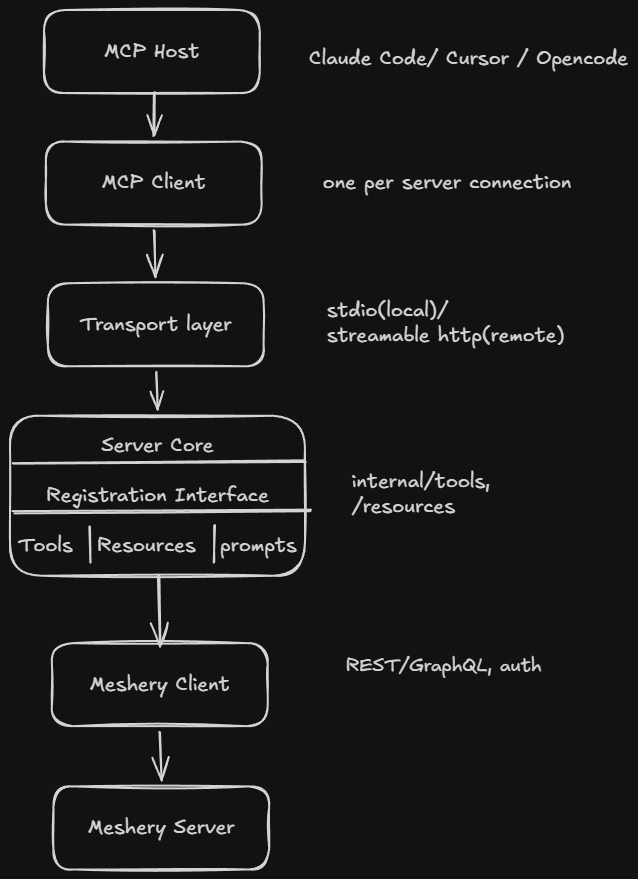
- Transport: stdio for local agents, streamable HTTP for remote agents.
- Server core: owns the MCP server, advertises capabilities, routes requests.
- Registration interface: one contract for tools, resources, and prompts (section 5).
- Implementations: internal/tools, internal/resources, internal/prompts.
- Meshery client: REST and GraphQL wrapper with auth, timeout, and retry. The only integration boundary between MCP surfaces and Meshery.
5. Registration interface
Every surface area registers the same way. The scaffold already establishes this seam with tools.Register. This section makes it a shared contract.
The contract is one small Go interface with a single method:
type Registrant interface {
    Register(s *server.MCPServer) error
}
- internal/tools exposes one Register for all tools.
- internal/resources and internal/prompts follow the same shape.
- A new tool is one file plus one line in Register.
A shared contract means contributors implement features consistently instead of each inventing their own pattern, and it gives reviewers one place to check registration.
6. Authentication and multi-tenancy
Tools receive an already-authenticated shared client. They never handle tokens, cookies, or credentials. Authentication lives in the client layer: token injection, context selection, refresh.
Named contexts support multiple Meshery instances (dev, staging, production) with context switching. Every call is authenticated and scoped, so an agent cannot act outside what the credential allows. No secrets are written to logs.
7. Transport and deployment
stdio ships in the scaffold and is the default for local agents (Claude Desktop, Cursor). Streamable HTTP follows (issue #5) with graceful shutdown, for remote agents.
The server runs as a local binary or a remote container. Multi-arch builds (linux/amd64, linux/arm64, darwin, windows) cover common platforms for local installs, since Go binaries must match the host architecture.
8. Meshery schemas and connection lifecycle
Tools that touch connections report schema-defined states (registered, connected, not found) and transition through them with intent rather than exiting or failing ad hoc. Errors use MeshKit error codes and structured logging, per the contributor guide. Meshery schemas are the source of truth for connection, component, and relationship data.
9. Surface catalog mapped to expected outcomes
| LFX expected outcome | MCP surface |
|---|---|
| Design lifecycle | list_designs, get_design, create_design, deploy_design, undeploy_design |
| Cluster connections | list_clusters, get_cluster, connect_cluster |
| Registry and models | list_models, get_model, search_components |
| Environments and workspaces | list_environments, list_workspaces |
| MeshSync topology, read-only | resources: meshery://clusters/{id}/topology |
| Performance testing | run_performance_test |
| Guided workflows | prompts: deploy_application, design_review |
10. Milestones
- Merge the scaffold (PR #28). Everything stacks on it.
- Shared Meshery client (issue #6) as the single integration boundary.
- list_designs (issue #30), the first read-only tool.
- Streamable HTTP transport (issue #5) with graceful shutdown.
- Registration interface landed as a shared contract.
- Environments, workspaces, clusters, registry, performance testing.
- Testing infrastructure (issue #16) and release automation (issue #15).
11. Open questions
- Should the MCP server register with Meshery Server as an adapter, and if so, what does that lifecycle give it that the shared client does not?
- Is internal/server the right home for the registration interface, or should it live elsewhere?
- Should the first tools land before streamable HTTP, or in parallel?
Feedback, corrections, and pushback are welcome on any section, especially section 3.